
Laser lithotripsy for urinary incontinence
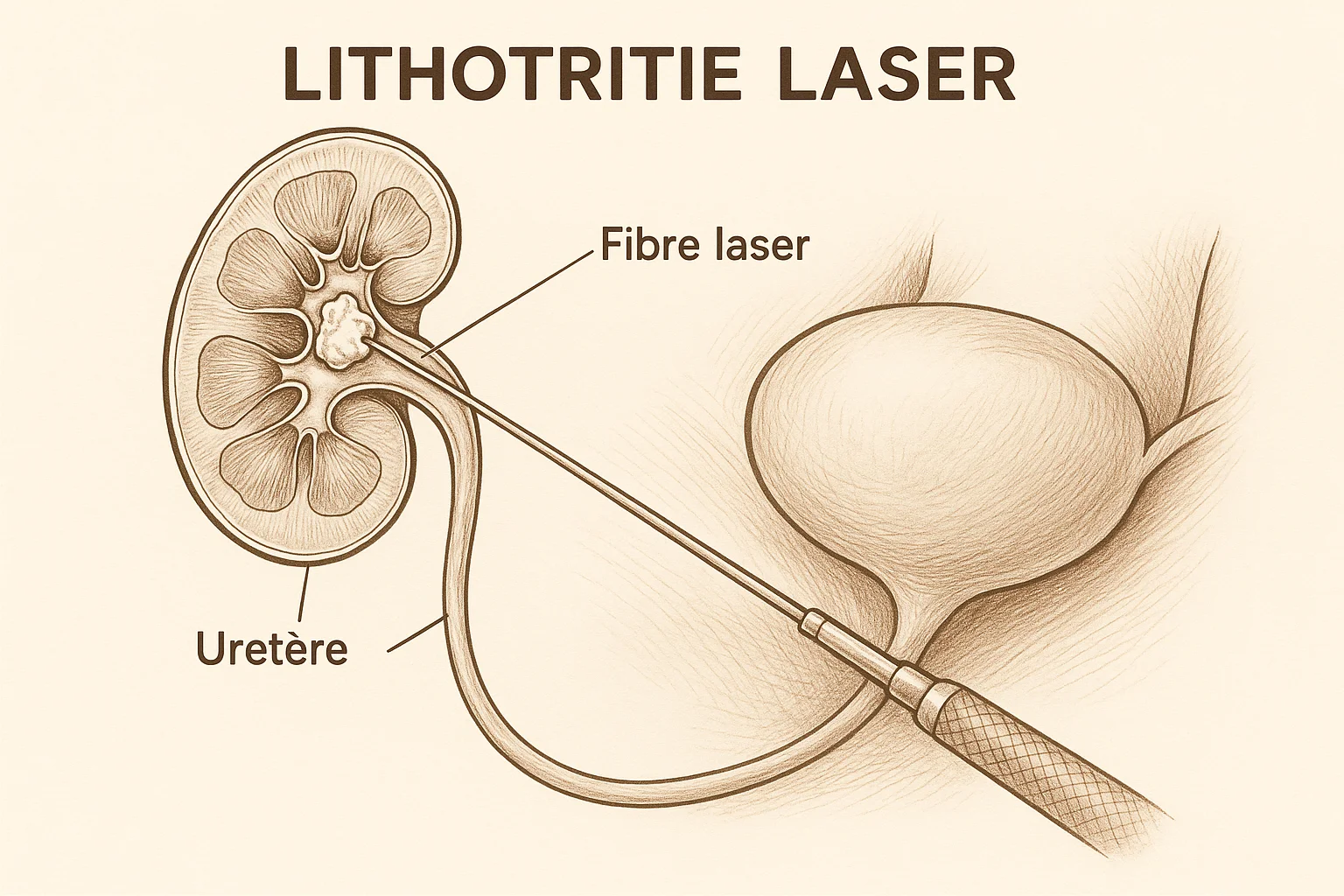
A minimally invasive solution for the treatment of urinary calculi
Today, laser lithotripsy is one of the most effective and least invasive techniques for treating urinary calculi, whether in the kidney, ureter or bladder.
This method enables stones to be fragmented by laser, without incision, without scarring, and with rapid recovery.
Dr Sébastien Dominique, urologist in Paris, uses the most advanced laser technologies (Holmium and Thulium) in the treatment of calculi, for personalized, safe and effective management.
What is laser lithotripsy?
Laser lithotripsy involves inserting a miniature camera (ureteroscope or nephroscope) into the urinary tract, through the natural channels (urethra, bladder, ureter), to the stone.
- A laser fiber is then used to pulverize or fragment the calculus.
- Fragments are either eliminated naturally in the urine, or extracted using forceps or endoscopic baskets.
- No surgical opening is required. No visible stitches or scars.

Indications
Laser lithotripsy is indicated in several situations:
- Symptomatic renal or ureteral calculi (pain, renal colic, obstruction)
- Failure of medical treatment or spontaneous expulsion
- Calculi too large to be removed on their own (usually> 6 mm)
- Recurrent stones
- Contraindication to extracorporeal lithotripsy (ECL)
- Endoscopically accessible bladder stones
Holmium and Thulium lasers: two complementary technologies
The Holmium:YAG laser is the most widely used laser in urology for stone fragmentation. It is effective on all types of calculi (hard, soft, mixed), whatever their location.
You can choose between :
- Fragmentation (into easily extracted pieces)
- Dusting: pulverization into fine, naturally eliminated dust
📌 Thulium laser (newer technology) offers enhanced precision, better thermal control and reduced bleeding. It is sometimes used depending on the surgeon’s preference and the characteristics of the calculus.
Procedure
- Performed under general anesthesia (outpatient or short hospitalization)
- Introduction of a flexible or rigid endoscope through the natural tract
- Direct on-screen calculation display
- Holmium or Thulium laser fragmentation
- Extraction of fragments if necessary
- Possible insertion of a ureteral catheter (double J) to facilitate drainage
📌 Average procedure time: 30 to 90 minutes, depending on the number, size and location of stones.
Advantages of laser lithotripsy
✔ Minimally invasive technique, without incision or scarring
✔ Can be processed for all types of calculations
✔ Access to difficult areas (renal calyces, high ureter) thanks to flexible endoscope
✔ Rapid recovery, little or no post-operative pain
✔ Excellent results with very high success rates
✔ Fewer complications compared to open or percutaneous surgery
Prevention and post-operative care
Post-operative care
- Same-day or next-day discharge, depending on the case
- Resumption of activities possible in 2 to 5 days
- Monitoring for moderate pain or blood in urine (transient)
- A double J catheter can be left in place for a few days to a few weeks to prevent secondary pain or colic.
- A post-operative check-up (imaging + consultation) is systematically organized to verify the absence of residual fragments and prevent recurrence.
Recurrence prevention
After lithotripsy, a metabolic workup may be proposed to understand the origin of the stones:
- Blood tests (calcium, uric acid, etc.)
- 24h urine analysis
- Nutrition and hydration recommendations
- Preventive treatment if necessary
Laser lithotripsy specialist
Dr. Sébastien Dominique, urological surgeon in Paris, welcomes you for consultations on :
✔ Assessing the need for laser treatment
✔ Explain the advantages and benefits of this technique
✔ Organizing your outpatient care
My video review
Find out more about the firm in this video.
Make an appointment
Dr Sébastien Dominique offers you a personalized assessment.